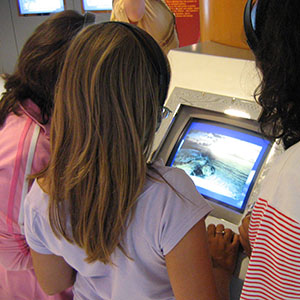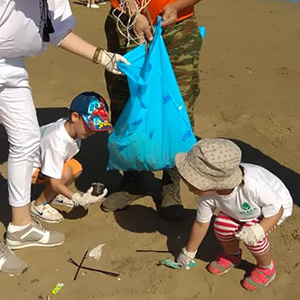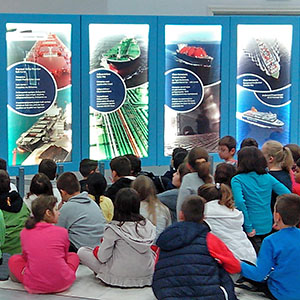


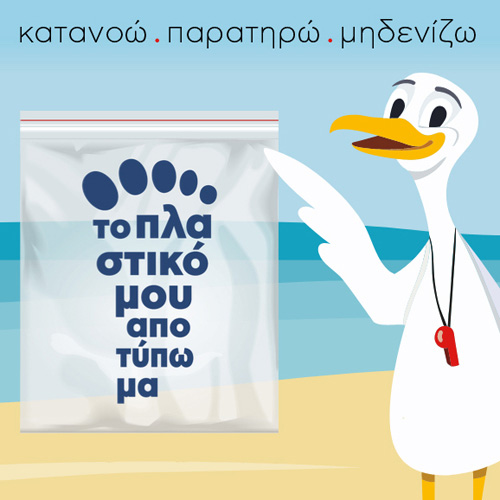

In 1983, HELMEPA began the launching of concerted annual public awareness campaigns starring the Association's "Seagull" and for the first time in Greece scouts and schoolchildren participated in beach cleanups, primarily in the region of Attica.
The adoption and cleanup of a beach also constitutes the most popular of the activities of the "HELMEPA Junior" environmental education program, offered since 1993 to schoolchildren, 5-13 years old, in kindergartens and elementary schools throughout Greece.
Since 1991, the Environmental Awareness Sector coordinates every September in Greece the International Coastal Cleanup (ICC) day. On this day, hundreds of thousands of people in over 100 countries come closer together by voluntarily implementing the same activity. This global initiative is coordinated by the Washington D.C. based non-profit NGO Ocean Conservancy.
Acting as national coordinator of this action in Greece, HELMEPA invites every September the Association’s members, cooperating entities and sensitized citizens throughout the country to contribute to this effort by dedicating one day to clean-up their favourite beach and/or seabed.
To support this activity, HELMEPA makes available to participants printed motivational material and a Data Card for the recording of collected litter, which they have to return completed to HELMEPA. The processing of collected data provides useful information on the composition and the sources of marine litter, which is then publicized to help sensitize all stakeholders towards the prevention of marine litter.
On Saturday, 17 September 2011, the International Coastal Cleanup Day completed 20 years of implementation in Greece, which was celebrated with numerous voluntary activities until mid-November.
In total, 2,600 volunteers from 144 public and private entities carried out 74 beach and underwater cleanups in 67 areas of Greece. Young kids and youth, members of the “HELMEPA Junior” and “Cadets” programs respectively, as well as others schoolchildren and teachers, office staff of HELMEPA member companies, municipal authorities’ representatives and Coast Guard officers, members of environmental organizations and sailing clubs, divers and simple citizens were among those who responded to this year’s invitation.
In implementing their cleanup activities along beaches, ports, lake and river banks and underwater, volunteers covered 62 km in total, collecting and recording in detail more than 12 tons of solid waste in order to direct it to the only appropriate place: garbage and recycling bins.
In the following table containing the «Top Ten» marine litter items, cigarette ends feature once again first in terms of actual numbers. The more than 100,000 cigarette ends, which were collected with great patience and effort by this year’s volunteers, if placed in line would form a giant cigarette end stretching over 2 km in length! Other items featuring among the top five are plastic bottles, straws, caps and aluminum beverage cans.
| Top 10 litter items on Greek beaches for 2011 |
Number |
Percentage |
| Cigarette ends |
101,202 |
59.9% |
| Plastic bottles |
12,562 |
7.4% |
| Straws |
11,365 |
6.7% |
| Caps/Lids |
10,757 |
6.4% |
| Aluminum beverage cans |
6,718 |
4.0% |
| Plastic bags |
6,350 |
3.8% |
| Food wraps |
3,075 |
1.8% |
| Glass bottles |
2,423 |
1.4% |
| Paper bags |
2,287 |
1.4% |
| Cups, plates, forks, knives, spoons |
2,011 |
1.2% |
| TOTAL |
158,750 |
93.9% |
As depicted in the following graph, 1 in 3 litter items originate from recreational and other coastal activities, while sea-based activities (fishing, pleasure craft etc.) seem to contribute less than 2.5%. Low, but far from negligible if we consider the volume of litter items of this kind and the associated environmental and aesthetic nuisance, is the percentage of waste such as appliances, tires, car parts, batteries, building materials, broken furniture etc. originating from dumping activities.
 |
Based on the above results, we may conclude that the problem of solid waste, instead of decreasing during the last 20 years, is still impacting and threatening marine and coastal ecosystems of exceptional beauty and ecological richness, not only in Greece but worldwide. On the other hand, it is encouraging that more and more people of various ages and professions are responding and are becoming motivated in a collective effort with regards to a major environmental problem of our times. These volunteers give an example of sensitivity and responsibility, an example of particular symbolic value in these difficult times.
HELMEPA congratulates the volunteers for their participation and hopes that all of them, and even more, will be present in ICC 2012, inaugurating another 20 years of voluntary initiatives and actions towards protecting our coasts and seas against marine litter.
Those wishing to learn more about the 2012 International Coastal Cleanup Day and to express their environmental awareness, by organizing or participating in a voluntary beach or underwater cleanup, may contact the Environmental Awareness Section. |